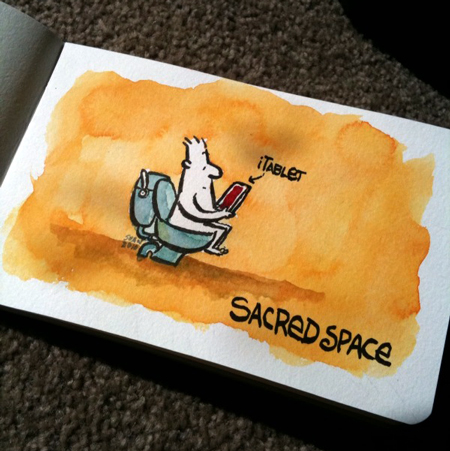
On December 25th, 2009, something quite remarkable happened at Amazon.com
For the first time in Amazon’s history, the sale of e-books overtook the sale of physical books. And on that specific day the paper book downslide officially began. The Kindle officially put the early set of nails in the coffin. What the Kindle didn’t complete, Apple’s iPad (and other book readers) will be sure to finish off.
But surely books won’t die.
The death of books have been exaggerated before and hey, they’re still around. Surely books aren’t going to die in a hurry.
Books won’t die; the paper book will die.
Less than ten years ago, it wasn’t uncommon to load up your car with dozens of CDs as you went on a trip. It wasn’t uncommon to have a stack of CDs in your lounge. Where are those CDs now? They’re all nicely ripped and sitting in your iPod, iPhone or at the very least on your computer. Only a dinosaur carries CDs around these days.
That dinosaur story applies perfectly to books
So you’re headed on vacation, and you pick up a few books to read. You want to beef up on a specific topic? Again, you pick up a few books from the store or from the library. In a few years from now, that idea of lugging around books will seem kinda quaint.
Why would you want to have dozens of books stacked around taking up space, when you can have them all on your Kindle or your iPad? Sounds too sci-fi? Well the librarians don’t think so. Across the planet, libraries have latched onto the digital media. One of the early libraries to lend out Kindles and Sony Readers was North Carolina State University Library. And the list of libraries giving out Kindles, Sony Readers and e-book readers continues to grow (here’s a partial list).
If this revolution to digital media seems unreal, Apple just wait till devices like the iPad catch on.
Kindles set out to allow you to download books or newspapers from anywhere. This means you could read the New York Times or just about any book in the Kindle store without having any access to a wireless hotspot or internet connection. However in order to keep this download small, all the fancy colour and graphics were stripped out of the Kindle display. This meant of course that you were largely restricted to text in black and white.
Apple’s iPad has no such restriction
Not only will the iPad work via 3G, but it will also easily work through wireless. Assuming Apple allows all of the apps to work on the iPad (as it does on the iPhone) what you now have is the ability to experience the best of both worlds. If you choose you can simply download the Kindle app onto your iPad and read a book (in a nice big font and size). If you choose to ignore the black and white, you may be able to download the book in full colour (Yes, publishers are already queuing up to have their books on the iPad). As if that were not dramatic enough, you’d be able to do it wirelessly through a choice of 3G or indeed over your wireless hotspot.
Digital books have existed for a while, but there’s always been a problem
You could indeed take your PDF and try and read on a flight. Or you could download a magazine from Zinio.com and read it in bed. But you always had to contend with a laptop at the very least. And I don’t know about you, but a computer doesn’t exactly come close to the happiness you get when reading a book. On a Kindle or iPad that frustration goes away. Now instead of lugging a computer to bed, I can prop up my iPad and voila—I have the very same, if not an enhanced experience.
Enhanced? How could it be enhanced?
Already you can bookmark pages on a Kindle. That should be standard on a tablet device of the future. Underlining, scribbling on the book, doodling etc., is just a matter of time. But that’s just the reading experience. What really kills the paper book is the storage experience. I can now store whatever I want in a tiny little device. And find the darned thing when I want to find it (As it is, I already buy books and store them on my iPhone Kindle app, just for reference purposes). With the iPad and future devices, this storage and convenience will become standard fare.
This news isn’t for the sentimental folks
Most of us who are sentimental about paper and books will resist even the thought of the ‘death’ of paper books. This column isn’t for the sentimentalists. It’s about business and how it will affect your business. If you’re an author, or if your company puts out documentation, it’s a matter of time before you will need to put your information in an ePub (e-publishing) format. And no, it’s not even PDF, though PDF may well do for the short term. You may be so in love with the paper book that you may see information like this as being overly sensational. And again you’re missing the point. The point is simply this:
1) Your business needs to understand the e-book format.
2) It needs to be ready to publish in the ePub format.
3) It may well turn out that you can continue to print a paper book as a collector’s item or a special bonus, but the paper book will simply become unfeasible in the long run no matter how sentimental you feel about it.
The paper book will fade away.
Film in cameras faded away. CDs faded away. Horse and carts faded away. And paper books will have it’s own ride into the sunset—still around—but niche and largely marginalized.
You may not agree with this assessment. But you have little choice in how history unfolds.
And Christmas Day of 2009 changed history forever.
———————
Next Step: Have a look at: Best Selling Product: The Brain Audit-“Sean has used every teaching method possible to make sure that you not only understand the sequence of elements needed to make people buy from… but the sequence soaks into your thinking pattern.
“I first bought the Brain Audit in 2002. It was 32 pages long. And I thought it was the best damn book on copywriting I had read! It laid down the entire sequence of elements that any successful salesletter or presentation needs to cover to make the prospect say “yes!”
I really thought that Brain Audit could not be improved upon. But year after year, Sean has been proving me wrong. He has improved upon it. And improved upon it. And improved upon it.
Sean's added more details to the Brain Audit. More stories and analogies. Better graphics (and fun cartoons!). He has used every teaching trick possible to make sure that you not only understand the sequence of elements needed to make people buy from… but the sequence soaks into your thinking pattern.
Today, Brain Audit 3.2 is 157 pages long! And its the best* book on persuasion you will ever read!
* Until Sean comes out with version 4.0 a year or 2 down the line. But you really can't afford to wait a year or 2 to take advantage of the Brain Audit, can you?”
Ankesh Kothari, Adventures of a serial entrepreneur, India
Judge for yourself The Brain Audit: Why Customers Buy And Why They Don't
———————
New Products: Introductory Price
1) Do you sometimes wonder if planning books are written just for the ‘organised' people?
Learn Why Most Planning Fails: And The Critical Importance of Chaos in Planning
2) Do you want to put some sanity into your design even though you are not a designer?
Learn how, you can immediately improve your design with some really simple tweaks.
4) How to Create Powerful Testimonials To Sell Your Internet Marketing Product. Find out the sec'rets…
———————
Read to join a community of like minded people?
“I was worried that this would be yet another expense where I didn't end up using what I had bought.”
“You guys are masters of making sure that we consume (what we've bought)! And so, I've learned a ton since I joined!
I love The Cave. I honestly haven't made the time to try out anything else or even look into anything other than the general discussion board! The other things I really like: Direct access and
insight from Sean, networking with other like-minded small business owners, the positive and encouraging vibe.
If you ask me: Would I recommend 5000bc I'd say: Of course! Because I've learned a lot!
One more thing I'd like to add. Thanks for being so dedicated to us. :)”

Marina Brito
Fairfax, Virginia, USA
Judge for yourself https://www.psychotactics.com/5000bc
———————



Paper books will never die.
The reason is not because of practicality or logic.
THINK ABOUT:
The feeling a paper book gives you when you turn a page.
The silent paper crack when you go to the next page.
The way it sits proudly in your personal collection after you read it.
The signature by the author that was done just for you.
And so on.
Books will live on because of the feelings they bring you, not because if they are practical or not.
Unless Amazon have changed recently, the Kindle is not available outside the US. Nor will they sell the kindle format ebooks outside the US.
Hopefully the itablet will have no such ridiculous restrictions on it.
I’ll be very sad to see paper books go though. I love the tactile experience of reading, the smell of the paper, the feel of it in my hands. No electronic device is going to be able to replicate that.
Oh yes, the Kindle is available outside the US. In fact, it’s available in your country too 😉 (No, not in New Zealand yet though. I’m sure it’s got something to do with our cell phone companies).
By the way, you can download all Kindle books via the iPhone even if you don’t live in the US. I’ve downloaded and read books while on vacation. I just didn’t have the luxury of a tablet sized screen. But contrary to popular perception, it’s very easy to read on an iPhone as well. (Of course I’d still appreciate the a5 size) 🙂
It is now? It wasn’t available here previously. I looked into it a few months after it was released.
And no iphone here, not for another 20 months when the contract on my Samsung runs out.
And just as a P.S. Amazon is giving away Kindles with a guarantee: Love it or don’t pay for it. That means you can buy a Kindle and if you don’t love it, you don’t pay for it.
http://www.techcrunch.com/2010/01/20/amazon-kindle-free/
And yes, you get to keep the Kindle anyway.
This isn’t related to the ebook vs. real book debate, but shows you how much of a theoretical threat the iTablet could be for the Kindle.
Here’s the Aussie link
http://www.amazon.com/Wireless-Generation-charging-shipment-Australia/dp/B000GF7ZRA
However, I’d wait for the iTablet if I were you. I’d have bought a Kindle a year ago, but now that would be out of the question.
Sean,
I couldn’t agree more. Paper books are on their way out. And fast!
I think you are right about the iTablet. It has potential to be the game changer, just as iPods and iPhones did in their category.
Borders bookstores recently went backrupt in the U.K. No doubt it’s the start of a trend that will soon find it’s way to the U.S.
The next question is: Will traditional publishers soon bite the dust too? Do authors really need to rely on publishers to create and distribute an e-book? If authors can publish their own e-book and make it e-reader compatible, and if they can market it online via their own website and mailing list, then what function does the traditional publisher serve? And if most e-books sell for approximately $10 each, as they do now, and not the $25+ that their hardcover paper versions do, is there even enough profit margin for publishers to want to stay in business? If I were in publishing, I’d be polishing my resume.
E-books needn’t sell for $10. In fact, for the first time ever, e-books (unshackled by the publishing system) could sell for more. A lot more. Or less. It would depend on the author of course.
I think publishers can still do a great job. They still have the ability to understand and use their knowledge of what works and what doesn’t. And they’ve been around for a long time working with very small margins (unlike the music industry). So if publishers pull their socks up, they can indeed do something about it.
What they could do is debatable, of course.
I’ll be very interested in this development. Up to now I’ve kind of ignored the Kindle – yeah it sounded nice, but nothing to get too excited about. But I wonder if you’ll be able to embed videos and MP3s into your PDFs and have it played on them the way it would be on your laptop.
THAT would be very interesting. (Be interested to see how pricing goes too).
funny, I’ve had an hp tablet for years and absolutely loved from day one. I’ve never understood why tablets didn’t become the standard then.
Besides being lightweight and highly functional, allowing the possibility to replace a paper notebook, what I really loved is using the digital pen as a mouse – no more carpal tunnel syndrome!
Plus it was / is fun and faster to use than a mouse.
Now apple just talks about coming out with a tablet and it’s being touted as a game changer everywhere.
i’m curious to see if it really plays out that way.
p.s. I’ve since switched to a netbook as my main pc, and am eager to see Google’s offering. That’s the game changer I’m looking forward to.
The ebook issue to me is much more desirable on my phone. I’m waiting for my blackberry to be returned so that I can use their free application for downloading books – no format restrictions like Kindle.
And, I always have my phone with me, so I would always have something to read. Lovely. 🙂
Doru,
I love paper books, scribbling, writing notes. I have over 24 file boxes of hardback and paper books. 24 boxes. I had to use excel to store the name, author, etc.
I would LOVE to have the ability to have all those on one device (provided my notes could be added along with my scribbles/references) AND the ability to SEARCH everything.
As for the feel, I agree. However, I tried out Barne’s and Noble’s Nook in store. It felt really good in the hand. And it allows you to lend a book to another Nook owner and you get it back in 14 days (never lose a loaned book again).
While I don’t know agree with Sean totally, because yes, you can still buy film, CD’s, etc. DVR’s didn’t end movie theaters or DVD’s. I do agree change will and always will occur. Industries will adjust as will people. And if the industries don’t pay attention to the people, the industry will have failure with the product.
Robert
With a paper book you don’t need worry about electricity or batteries. I can’t see it disappear in the near future.
Nothing ever disappears. But usage gets dramatically reduced. For publishers it would make no sense to print paper books when a huge chunk of the market is headed to digital books. CDs and film still exist, but do you know any of the younger generation who’s bought a CD or film recently?
Trends are trends till they become a way of life. The digital book will become a way of life. And someday paper books will become collector’s items.
R.I.P. is all very well – until you need something that was done on ‘old technology’. You know: archive material. A copy of the ‘formerly fashionable’.
I have books on my shelves that are 100+years old (the paper was better quality in those days). And I have information on real live genuine B drive floppy disks that I need ‘antique’ equipment and software to access.
How long before the Kindle and Co are similarly obsolete and someone coughs over the cost of grandfathering?
And how easy is it to tuck a Kindle under the pillow to pull out to read in the wee hours of the night?
And how well do tablets accommodate a large typeface without the need for irritating horizontal scrolling? Or maddeningly small chunks of copy on the screen?
If/when this technology gets across the Chasm to full mainstream, I wonder if it will go the way of the cell phone – and just as rapidly. There’s all the brag of being an early adopter followed by a scadload of recyclables as the devices morph month by month. I’m prepared to play Late Adopter or even Laggard on this one.
I had three instances in the last month, where clients and friends completely refused to accept a physical book. This was a wonderfully printed copy of the Brain Audit (signed copy too).
One of my friends (he works in a prominent position at Google) suggested I put the book in a Kindle format. Another asked if he could give away the physical book and keep the digital version. A third simply asked for the PDF version to read on his laptop. In all instances, I was going to send them the book, at my cost. And in all instances they found it more convenient and feasible to take on a digital format.
We’ve got digital books (have had them on sale since 2002) and I can tell you that physical books are very prized indeed. But the tide is changing. Many folks are purely interested in the convenience. And the paper market will continue to decline till it becomes niche.
There’s a difference with books compared with CD’s and movies. With CD’s and movies you have always needed equipment to use them, and the development of the techniques and machines involved is not a very big step compared with changing reading habits from paper books to electronic.
I agree with Doru. I love paper books. I still have books from my childhood and just looking at the spines brings back happy memories.
I don’t think paper books will ever die. They may instead become limited addition collectors items for true book lovers. Plus reading anything digital hurts my eyes after a while.
I don’t disagree, but I still feel paper books will be marginalised. I use a fountain pen and fill my fountain pen with black ink every week.
I don’t see very many others using a fountain pen. Or even a pen for that matter. Most of my friends only ever use a pen for filling in forms or to sign something.
I did exaggerate the death of the book, for sure. However I can’t see how it won’t become niche and marginalised in future.
I’m sitting in my office/library surrounded on three sides by shelves full of books. There are at least 500 books in here and I have boxes of books we haven’t unpacked yet. I have at least 50 books in the garage I plan to sell on eBay.
I absolutely love paper books. I bought a paperback and read it last week. I finished a hardback tonight.
But I also own a lot of ebooks. Some of the important ones I use regularly I’ve printed out and put in binders.
But if the Apple tablet does what I imagine it can, I’ll want one. My kids, aged 20 and 26, both own Kindles and love them. Both my kids also read lots of paper books.
I think there will be a decline in paper book sales and e-books will take over the mass market.
I think there is room for both types of books. Some of our classic books are very nice with gold edges and leather bindings. These will be passed down to future generations. The paper back will be passed to friend and sold or given away. They simply won’t last.
It took me a long time to get used to buying music digitally. My wife still buys the CDs at the store. I do both. CDs and downloaded. I sure love my iPods and my iPhone.
We’re about to buy a usb-VHS player so we can load all of our Disney movies onto our computers so our unborn grandkids can watch them over and over and we get rid of all the tapes. We’re already blue-ray owners.
Technology always advances. We can either accept it and use it, or get left in the dust.
Sean, I’ll take those three copies off your hands if you’re looking for someone to give them to…. I’m sure I can find three people who would love a hard copy of it!
Something else I just thought of, is that we’re running out of trees. Old growth forests, and the land to grow plantations for paper pulp. Recycled paper requires virgin pulp to mix with, particularly for high quality paper. This is going to be a factor in the move away from hard copy books.
Here’s a side story as well that may be of interest.
http://www.tuaw.com/2010/01/25/is-jobs-looking-to-overhaul-education-with-the-tablet/
too bad you didn’t put my post up Sean. . ..
😉
Which post was that, Robert?
I agree with all you say and I’m happy that the truth about the publishing industry comes to light. It’s not dying, it’s mutating.
I’m a new author/illustrator and I’m currently preparing a book which content is completed with the collaboration of my blog readers. I’m giving away the ebook for free. My readers/fans will be also able to purchase a limited customized and hand signed paper version.
I believe that the furute of the publishing is in the use of the Internet and digital media to reach a wider audience and sell the product in a unexpensive way.
Then, for a minority who are fans and still love paper books, we can offer alternative customized paper version with bonus material.
We’ll see what comes out of this experience in a few months but so far you can follow up the making of my book, step by step, at my blog.
The problem is that it is not only a technical question. It is a copyright question. Publishers and authors won’t be able to protect their intellectual property. See the example of music industry, or the torrent sites with thousands of e-books. You can find e. g. thousands of computer books in torrent sites, and download in a minute. Authors and publishers won’t be so enthusiastic if amazon or Apple won’t be able to prohibit the illegal downloads. If something is protected by a software, it is not protected. See e. g. http://news.bbc.co.uk/2/hi/8428126.stm
Publishers and authors have already lost that battle a while ago. If you walk through the streets of India or China, for instance, you’ll find the books (paper books) for as little as 30 cents. It’s not that Indians and Chinese (and the rest of the world) don’t buy books in stores. They do. But the problem of copyright has already been in trouble for well over 25 years.
The point is that whether an author likes it or not, the e-book will exist. It has to exist because it doesn’t make sense not to exist. The torrents will also exist, and that’s just part of life.
There will always be buyers and there will always be pirates.
Uh, Paul, The Brain Audit has been printed. Paperback, 157 pages….. http://brainaudit.com/blog/
The attachment to the printed book is not merely sentimental. Book lovers do not simply love reading. They love BOOKS!. There is the not small matter of appreciation of beauty – texture, fine typography etc. Most of the books I BUY are very beautiful … art and photography books for example. These survive reasonably well in a high resolution PDF on a large monitor, but on a tablet or phone in Kindle or ePub format? There’s no comparison.
Ebooks, from my point of view, are fine for information books, and perhaps text-only books like novels (though I’ve never read a novel onscreen, and have no desire to).
I also have absolutely no desire to have thousands of books on a portable device … too much choice results merely in indecision.
I agree that ebooks are changing the face of the publishing industry. This is both a good and a bad thing. I have collected heaps of ebooks, but have read only a fraction of them, and once I’ve filed them away I forget they are there. You can’t ‘search’ for something you’ve forgotten about! (I’ve read in a number of places that it’s estimated less than 10% of the books downloaded are read.)
Good for the self-publisher, yes. I am no fan of the publishing houses. Good for the reader? Maybe. But we are already seeing a proliferation of absolute rubbish … badly written, badly edited (if at all), and badly formatted (much of the typography is appalling). Anyone can write a book, right? Yes, but writing (and producing) a GOOD book requires specialist skills. We are being flooded with quantity; finding the quality will be a challenge.
The format is another issue. A well-designed PDF, specifically formatted for online reading is one thing … but thus far I have found other formats a trial to read. The epub books I’ve encountered are ghastly. (If anyone can direct me to well-designed epub books, I’d be grateful if you’d let me know.)
A year ago, at a Writers’ Festival, I attended a seminar on the future of the book. The presenter believed that the whole nature of the book would change (eg, becoming an interactive experience). I believe he is right, and I find this quite exciting. He also suggested that there would be a growth in demand for beautiful books, and bookshops would need to become like art galleries, displaying these books to good advantage.
An example: The Box, by the Terma Collective. http://www.lostborderspress.com/books/detail.cfm?book_id=14
I recently acquired one of these, and the description on the website does not do it justice. Truly a ‘thing of beauty and a joy forever’.
The printed book may well become a thing of the past, but the world will be a poorer place.
There is one more thing. When you “buy” an e-book to read in your Kindl or iPad, do you actually download a copy of it that is yours? The way I understand it, Apple or Yahoo could any time erased it if they chose for any reason
It also opens up the possibility to change the content of a book without anybody knowing. Facts could be changed in all books from one day to the next.
I’m not sure how they could do that. Logically you’re backing up stuff, so even if they updated a copy, you could restore it from elsewhere.
But anyway, that’s hardly the point here. The point is that this is the way things are going to be whether we like it or not.
The link to the Amazon data is at:
http://www.macworld.com/article/145334/2009/12/amazon_ebooksales.html
Lord, how I hope you are wrong. Tragically however, I suspect you are right. What a sad day…
When a Kindle, iPad, et al is the shape, smell, feel, and has hundreds of flexible, paperlike screens (pages) that one can turn and flip back & forth, like a book, then I will consider purchasing one and download e-books onto it.
Until then, should your scenario come to pass, I will continue to buy reams and reams of paper and ink cartridges, and print out my reading materials. Having grown up in the computer age, I understand all to well, that nothing is truly backed up until it is printed out.
In the future Kindle and iPad will be as old fashioned as a computer from the ’80s. A more booklike object the e-paper will be certainly most popular. But the dispersion of e-book or e-paper doesn’t only depend on the demand of people.
Publishers and authors won’t tolerate the illegal copies after a while. Amazon, Apple or other companies won’t be able to protect their intelllectual properties. Yes you can also buy illegal paper copies of books in some contries, but not in the main markets. You can buy illegal copies of e-books everywhere, so e-book is unprotectable. That is a difference.
Big perfume companies try to protect their brands from fakes. Publishers will do the same. Currently I don’t see the possibility of the protection of the intelllectual properties on digital platform. So the success of e-book doesn’t depend on you or me but authors and publishers.
Some wise soul once said, ” There are no true endings in history”.
That will also be true for paper books. Yes, E-books are great too. But too often people in the west seldom look too far.
The world is in “EnglishMania”, but worldwide E-book mania may be some time off yet. So the demand for paper books world wide could actually increase before they decrease.
Of course e-book costs virtually nothing to publish and could be sold cheaper.
But paper books can be self published in the country they are ordered online through smarter publishers. At the very least they will be a $20 business card, giving the author more media credibility than a e-book.
Will the paper book die? History says NO.
Ebooks don’t cost nothing. In fact the cost of producing an ebook is almost 80%-90% of producing a physical book. All the proofing, design, editing etc still costs thousands of dollars (we’re talking about professionally produced books here). So it’s a big myth that e-books cost nothing. Overall the public is just misinformed and the myth pervades.
Trouble is, self-publishers are most reluctant to pay appropriately for professional design … or so I’ve found (I’m a graphic designer specialising in book design). I suspect they are also reluctant to pay for professional proofing and editing too, but they are more likely to recognise that’s necessary. Most people, I’ve found, think design has only cosmetic value.
When I said e-books are virtually fee to publish, I was refuring to mainly new authors writting non-fiction. If the content has value to enough people, a perfectly produced e-book isn’t as important. Content is what people look for.
To the graphic Designers out there: I’m a graphis designer but I don’t call myself one. I’m a ‘Visual Communicator’. We visualize infomation, concept & stories. We don’t make things pretty. E-books need this as much as anything. Hold your head high. You provide a alot of value.
Sean, I can’t agree that the cost of producing an ebook is 80%-90% of producing a physical book. Of the pre-print phase, yes. But after that there is virtually no charge per copy for ‘production’ of the ebook, whereas the print book + distribution costs can amount to a small fortune. POD, of course, can make an enormous difference … but POD is only cost-effective for simple paperbacks.
‘Visual Communicator’ eh? I like that Steve. I call myself a ‘book artist’ … I’m focusing on handmade & limited edition books. Probably no money in it, but we’ll see.
And you’re right, ebooks need the ‘visual communication’ approach as much as any. But it seems few realise it. I’m actually amazed at the dreadful quality of the vast majority of ebooks … even from authors who you’d expect to know better. My pet hate … ebooks that are hundreds of pages long, with no bookmarks, and no links from the contents page, and designed for an A4 (or US letter) printout, so when you ‘fit to page’ you can’t read it.
These are not my figures. They’re figures from the publishing industry. Printing is not as expensive as you think. You can print a thousand books well for about $3 a piece. When you see that the retail price is about $20-30, that gives you the costing of the book.
Hmm … none of the self-publishers I know have ben able to achieve those costs. And in any case, if $3000 = 20% that would mean the rest (graphic design and editing), would have to amount to $9000, which is unlikely.
Paper books won’t go anywhere. And here are the reasons why:
It’s 1000 times more pleasant to read book on paper rather on screen. For gods sake, I’m spending too much time on screen already, so at least I can read a book to get away from it (I’m a webmaster).
Paper book is a perfect gift, you can even write your own words to the person you’re giving it.
So saying that paper books will go away is the same as saying that people won’t go to cienema anymore and woth movies on XBOX, or nobody will go fishing, or anybody won’t play basketball in the yard, but instead will play NBA 2010 on XBOX.
CDs, DVDs lost over ipods, iphones because they were used to store the same (digital) media (same user experience), but ipods are alot more convient for this.
You can’t make the same comparison on paper books (analog media) and ebooks (digital media, be it on DVD or on ipod) – its 2 completely different experiences.
Of course, some peaple prefer paper, some e-books.
I think, whose who read just because they have to read in case to get knowledge – will buy e-books (technical docs, how to be rich in 5 min. etc).
Whose who like reading masterpieces of written word will choose paper books.
I don’t want to refute this point, but two authors I gave a book to, asked me if I could have a Kindle or PDF version. There’s no doubt the paper book will continue to exist. But in a way it will die. And the influence it has wielded will continue to decline. It’s largely influence that is going to matter here.
E-book verses paper book:
There is a media term called: ‘Media Dependancy’.
This is when content needs to be modified to suit the medium used. eg: A novel is made into a movie. The movie version has scenes deleated but has music. The same concept can also apply to e-books. They don’t have the same sensory appeal as a paper book but you can put in links etc.
“Quality is always in the minority”
Ebooks are like anything else. You sometimes have to sift alot of dirt to find gold. As long as your ebooks have insightful content and great presentation, readers will find you.
I am surprised at how many people are vehemently defending paper books. It reminds of several instances in my past of technology debates with people who were 100% convinced that “new stuff” could never replace the old ways of doing things.
Instance #1 – In high school I worked for a large daily newspaper taking classified ads over the phone. All of us in the call center typed the ads on typewriters. Yes, we’re going back many years. One day management said they were considering ordering computers for us. Everyone except me (I was the youngest in the department), was dead set against giving up their typewriters. They were sure computers could never replace typewriters. Um, yeah right.
Instance #2 – I worked for an ad agency. The graphic designers all did their designs and layouts by hand on paper. The writers at the ad agency had just switched from typewriters to PCs. I remember telling the 4 graphic designers that soon they’d be on PCs too. They unanimously said, “No way!” They argued that there was something magical about putting pencil to paper, and a PC could never replace that. Um, yeah right.
Once e-readers provide the means for e-books to offer an enhanced reading experience over paper books, such as what Apple is promising with its iPad, people will make the switch and never look back.
Yes it is true people sometimes can’t imagine that one technology can replace another. But was the radio replaced by TV, or the propeller replaced by the jet engine.
The technolgies that are replaced are often the input devices like typewriters and pencils. But output devices seldom die. They are the media devices. These output devices only change their role in our lives.
People aren’t blindly defending the paper book. They just realize that it’s place in the marketplace will change because of ebooks but no medium has ever been replaced.
Hmm, that’s interesting. I’m not quite clear why output devices can’t be replaced. I’d see a DVD player as an output device, but I’m sure it would be replaced in time (if not in a few years). A lot of devices are input and output. What is a computer? Input or output? A case could be made for both, couldn’t it?
However the main point of the article isn’t whether the book will go or not. But rather how to get ready for the next wave.
I have to say I was in this very boat when blogs came along. I kept insisting that blogs were a waste of time. Today we know better.
I have to say I’ve been so wrong before, that I had to put this out for those who want to be on the cusp of the wave when it arrives. For those who insist on the book being dominant, they will find that it will continue its dominance for a while, and then get marginalised. That’s when things will really hurt.
This article isn’t so much about today. It’s more about how to get ready for 2012. And of course time will tell 🙂
And just to be sure, I’m learning all I can about ePub (yes, you can use InDesign to create ePub files) and also working on a strategy to have our books ready for Kindle—but mostly for the Apple Store.
Firstly I would like to say Sean how much I have enjoy the exchange of perspectives here.
Yes I can imagine DVD players in danger of disappearing to the shadows someday (like the 8mm projector). But there will always be a ‘movie player’.
The computer is an input and output device. But for the content creator it’s value is that it is an imput device. For a passive audience it’s mainly an output device.
Ofcourse your blog proves that readers don’t have to be passive readers.
Now to the future: I too am looking to the day when I can take advantage of the growing ebook marketplaces as an author. But I’m worried for anyone who publishes there own ebooks without a wider income stratedy to support themselves. Without other related income streams and marketing strategies that suit them.
We all need to look at not just all the possible digital products out there but physical products, speaking, couching, community membership, affiliate relationships. And marketing with podcasts, blogs, newletters, interviews, articles and emails.
Ebooks are a great start but not a stratedy in it’s self.
Sean, thanks again for your thoughts.
No it’s not a strategy in itself.
But be aware that it’s a great strategy all the same. Many businesses such as ours would not exist as it does, if it wasn’t for one ebook (16 pages too) that we published in the year 2002.
Some businesses have grown on the basis of single medium. Some chose video. Some just had one app. And some rode on the blog wave. In every tech cycle there is the chance to ride the wave, and in every cycle there are people like me who say: Ah, how can that work?
That is a mistake.
Instead of defending the paper book (which from the looks of things needs no defence if indeed it is to continue its domination) spend some time learning about the new phenomenon.
That way you won’t get caught flat footed when the time comes to actually use the technology of the day.
Hi,
After selling and developing digital editions since 2005, we as one of the pioneers in this market have been frustrated at the slow take up of digital products but over the years proven that clients are receptive for instant delivery and are willing to read on both the desktop and laptops.
It’s great news to read about the great advances in the hardware and software recently for reading books and magazines and think this market is going to be an exciting on at that.
The technology and it’s delivery is ever changing, the quality of the content should not.
Kind regards,
Anthony
Managing Director
DIGITALNEWSAGENT.COM
I am an avid reader. I agree that the feel and smell of a brand new book can always beat the feel of an ereader device. But, I do agree that no one, even an avid physical book-lover like me, should doubt that a change will be occuring in the near future.
We can defend physical books, but that would be ignoring the inevitable. The fact that in the near future, more and more people will be buying ebooks for convenience. But, avid booklovers can keep the books they have and back them up on the devices. Just in case something ever happened. That way, we still get those books we loved and we are part of this new wave of technology.
I may be only 19 years old, but I believe that we can have the memories of real books, and still be in the new ebooks.
I do feel that books will never die, because of the sentimentality of the true booklovers who will never let it die. But I also believe that we should not worry ourselves with the decline of use in physical books.
As long as there is some documentation of stories, i.e. the ereaders, and the future generations can use these stories to travel to faraway lands using their imagination, that is the most important thing. There will always be stories. Just be happy that there is a technology that helps to bring these wonderful stories to future generations. The stories that made us love reading.